
InfoHunter
InfoHunter is the innovative Risk Intelligence platform created to support companies, professionals, and decision-makers in the preventive assessment of individuals and companies.
-risks-
The risks for companies
The context in which companies operate is characterized by systemic risks, often not fully visible. The absence of a structured approach to their identification leads to managing them reactively, with far higher costs than a preventive logic.
A supplier with unknown precedents, a partner with reputational exposures, a candidate with an opaque profile: the risk is real, often invisible until critical issues emerge and more in-depth analyses are carried out.
-The problem-
Analysis processes are often slow, fragmented, and incomplete
- Information asymmetries between departments and decision-makers
- Resources scattered across different providers and tools
- Analysis times incompatible with rapid decisions
- Difficulty in transforming data into concrete assessments of risk
- Critical areas systematically overlooked: reputation, relationships, context.
Increasing complexity, outdated processes
Organizations invest in numerous tools and providers, distributed across teams and functions, which generate complex information to integrate and interpret, as well as significant costs, while internalizing the entire analysis activity.
Determining aspects such as reputational risk and intelligence often remain at the margins of the decision-making process.
InfoHunter enables these problems to be solved by integrating into a single platform:
01
Reputational Intelligence
OSINT analysis to reconstruct the reputational profile of companies and individuals: media exposure, relationships, risk signals, and context.
02
Transaction Services
Information support in extraordinary transactions and commercial agreements. We provide a structured preventive analysis that supports the negotiation process.
03
Risk Reduction
Preventive identification of operational, legal, and reputational criticalities to anticipate exposures to risks and decision-making inefficiencies, rather than merely managing them. Entrusting the analysis to a specialized third party is a risk mitigation choice.
04
KYC & Due Diligence
Collection and analysis of information on individuals and companies for KYC, onboarding, and validation processes for suppliers and partners. We reduce timelines and standardize processes without having to rely on multiple providers.
05
Compliance & 231 Support
Structured and verifiable information in support of models. Integration of information useful for organizational models (Legislative Decree 231). Our reports are designed to integrate smoothly with corporate compliance processes.
06
Investigation Support
Information support for HR, Management, and Legal in situations requiring in-depth analysis of specific individuals. From pre-employment checks to disputes, through to investigative support on anomalous conduct.
InfoHunter
The AI platform for investigating and assessing counterparty risks
InfoHunter is an investigative Intelligence platform developed by Vigilar Group SpA, enabling rapid access to a structured risk analysis on companies and individuals, with language suited to compliance, management, and decision-making processes.
Its artificial intelligence is designed to collect complex and fragmented data from open sources and transform them into concise, verifiable, and decision-oriented reports.
-LEVELS OF ANALYSIS-
30–45 minutes
OSINT Automatic
Through the platform, an artificial intelligence engine analyzes open sources, web content, public information on the investigation target, and all individuals or companies found to be connected and of interest. All collected content is then reprocessed into a structured report with a reputational focus.
Ideal when there is a need to obtain immediate results.
2–5 working days
In-depth Investigation
The second-level investigation integrates OSINT reputational analysis with data from certified databases, allowing the case to be enriched with legal and economic risk indicators. A Vigilar Group intelligence analyst verifies the findings, removes false positives and non-relevant data, delivering a more complete and reliable report.
Ideal when there is a need to obtain immediate results.
-How it works-
An intuitive and user-friendly interface allows users to launch searches independently, in just a few simple steps from their own account. The platform can be used by different corporate functions and teams.
01
Target input (company or person)
02
Collection and processing of OSINT data
03
Automated analysis with proprietary AI
04
Structured output accessible from the platform or exportable as a PDF

InfoHunter allows users and corporate groups to be configured with dedicated access levels: each team views only the cases launched or assigned to its own area of competence, ensuring the confidentiality of information even between different departments of the same client company.
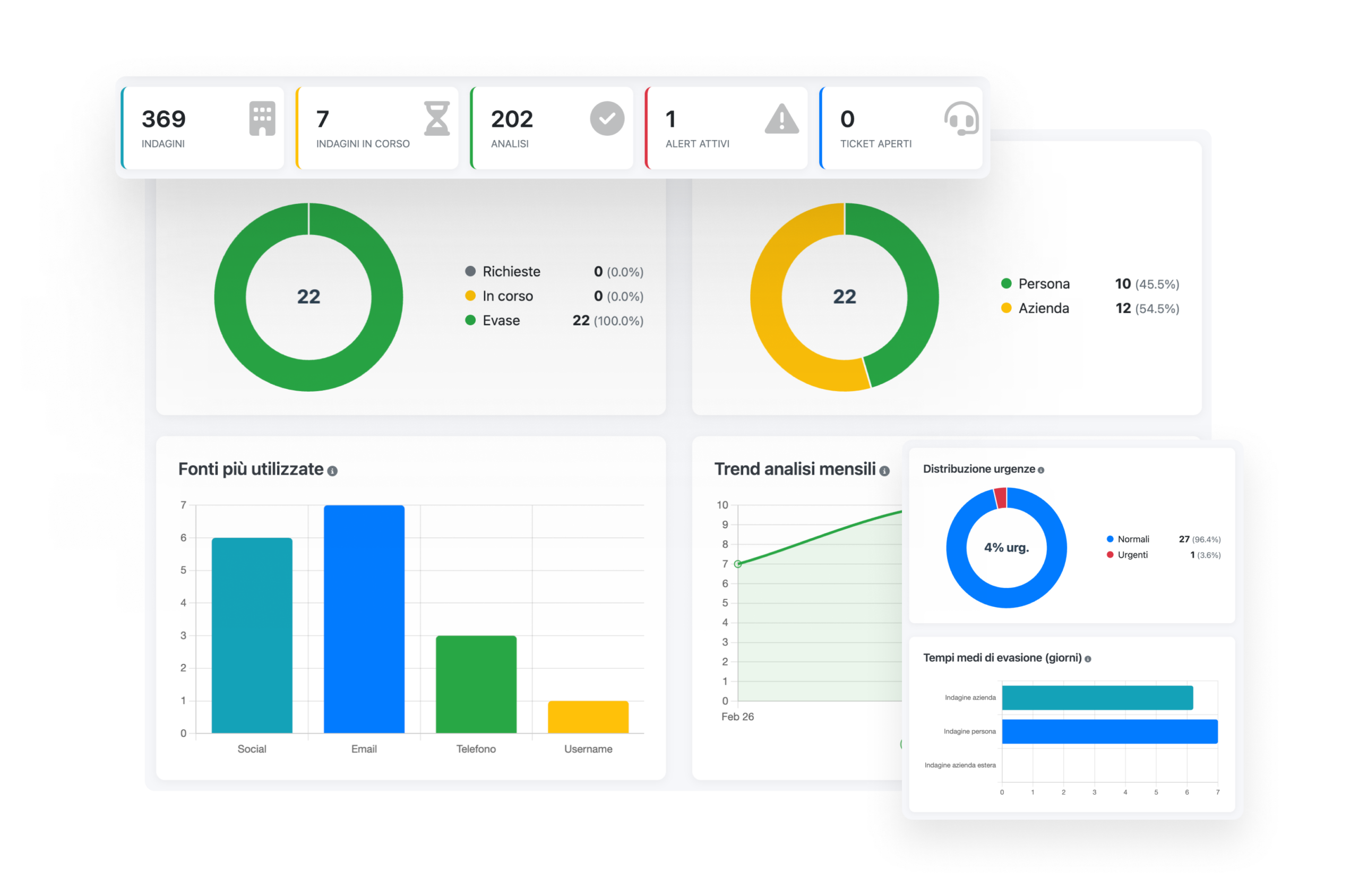
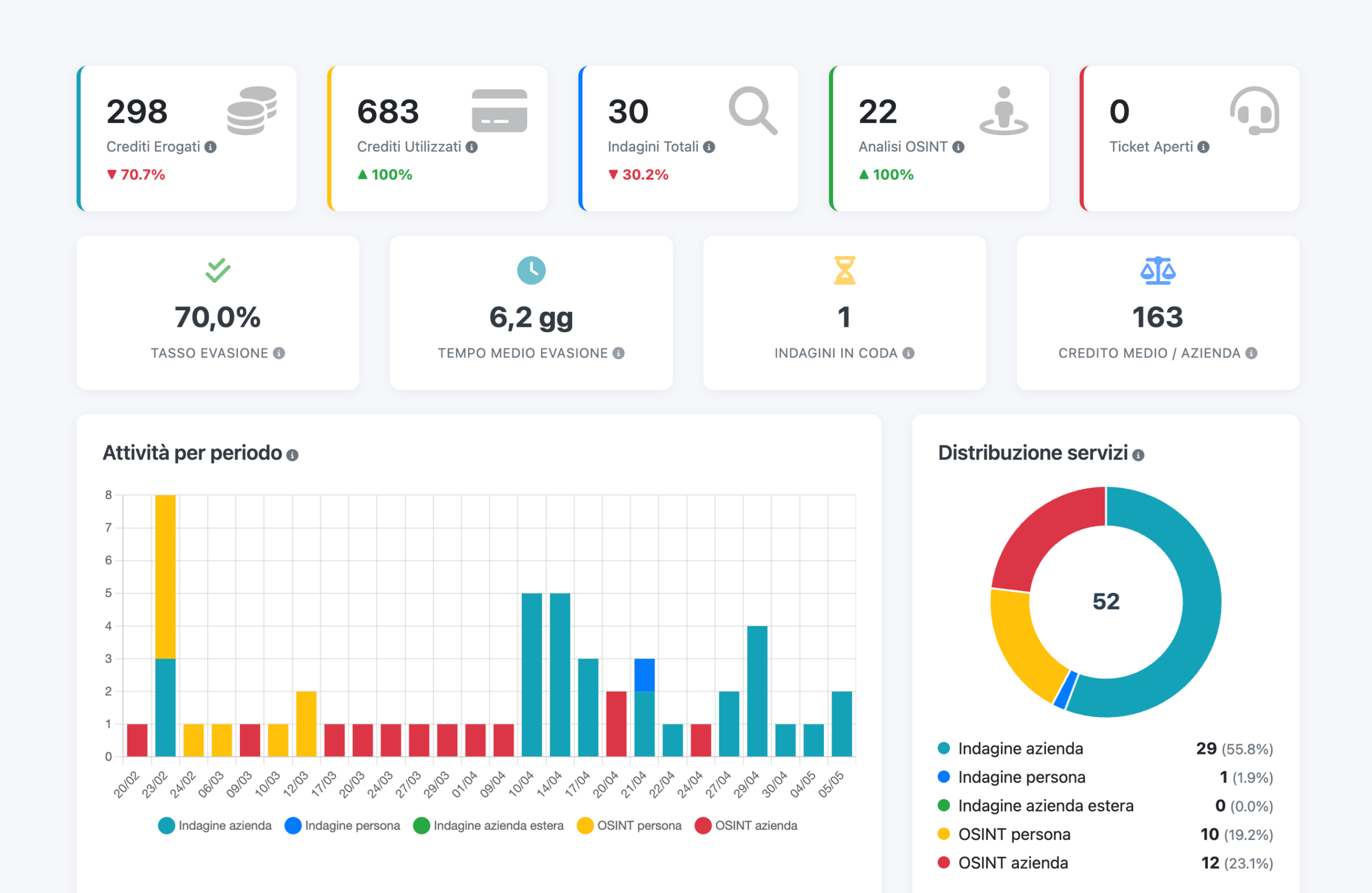
The platform allows users to monitor the number of checks launched, the status of cases, and the overall impact that InfoHunter is generating within corporate decision-making processes.
Who has already chosen
InfoHunter



-Q&A-
Frequently asked questions
What is InfoHunter and what is it used for?
InfoHunter is a proprietary investigative AI platform developed by VigiLab, Vigilar Group’s research and development laboratory, after a process of approximately three years involving ideation, development, testing, and beta testing.
The platform, the first of its kind in Italy, was created to support companies and professionals in the preliminary assessment of risk associated with individuals, companies, suppliers, commercial partners, candidates, or other relevant counterparties.
InfoHunter makes it possible to transform information available through lawful channels into a structured information framework, useful for identifying alerts, anomalies, reputational criticalities, corporate elements, economic-financial indicators, and risk signals worthy of further investigation.
Who is InfoHunter intended for?
InfoHunter is intended for companies, corporate groups, professional firms, and organizations that need to verify, in a rapid, structured, and documentable manner, the reliability of the subjects they enter in contact with.
The platform can support various corporate functions, including procurement, compliance, legal, risk management, HR, tender office, commercial management, and general management.
It is particularly useful in the assessment processes of suppliers, partners, subcontractors, clients, candidates for sensitive roles, senior figures, shareholders, directors, or counterparties involved in commercial, corporate, or strategic transactions.
What distinguishes InfoHunter from a traditional investigation?
InfoHunter allows preliminary checks to be carried out on a large number of subjects, reducing time and costs compared to many traditional investigative activities.
The objective is to help the company allocate its investigative budget more intelligently: instead of immediately investing significant resources on every counterparty, InfoHunter allows the most critical profiles to be identified quickly and further in-depth investigations to be directed only toward subjects presenting alerts, anomalies, or indicators worthy of attention.
With second-level investigations, InfoHunter can deliver, in approximately 48 hours, a structured and analytical information framework useful for supporting more informed corporate decisions.
Does InfoHunter use lawful sources?
Yes. InfoHunter operates through open sources, public registers, legitimately accessible databases, and authorized tools.
The platform does not use unauthorized access, does not violate IT systems, does not acquire data through unlawful channels, does not consult restricted databases, and does not access SDI systems.
The value of InfoHunter does not lie in obtaining restricted information, but in its ability to collect, correlate, and interpret lawfully available information, transforming it into a clear risk framework that can be used by the company.
Is InfoHunter GDPR-compliant?
InfoHunter is designed to operate in compliance with the GDPR and with the principles of lawfulness, minimization, proportionality, security, and purpose limitation.
Data processing is carried out for the purposes of verification, due diligence, risk prevention, reputational assessment, and decision-making support. The specific methods for data retention, access, deletion, and management may be contractually defined based on the client’s needs and the applicable internal policies.
What role does artificial intelligence play and how are data protected?
InfoHunter uses a proprietary investigative AI model developed to support the analysis and organization of information relevant for risk assessment purposes. InfoHunter does not use external commercial AI engines.
Data processed through InfoHunter are not transferred to third parties nor used to train external commercial AI systems. This allows the information to be kept in a controlled environment, strengthening the security and confidentiality of the checks carried out by the client.
In the more in-depth levels of analysis, the technological output is integrated with the assessment of a Vigilar Group analyst.
Does InfoHunter verify criminal records or access restricted databases?
No. InfoHunter does not access the SDI, does not consult Law Enforcement databases, and does not acquire restricted criminal data or data not accessible to the public.
The platform does not replace criminal record certificates, official certificates, anti-mafia checks, mandatory AML checks, or assessments carried out by the competent Authorities.
InfoHunter can, however, detect, through lawful and open sources, any publicly available elements with reputational, judicial, corporate, or informational relevance.
Can InfoHunter identify risks of connection with critical or criminal contexts?
Yes, within the limits of lawfully available information. InfoHunter can highlight indicators of possible exposures, proximity, or connection of a subject to critical contexts, reputationally sensitive environments, or criminal networks.
The platform does not make accusations, does not attribute criminal liability, nor does it establish criminal affiliations. Its objective is to identify warning signals that may make a profile worthy of further investigation.
Is the report generated automatically or reviewed by an analyst?
It depends on the selected level of analysis.
First-level investigations are designed to provide rapid and automated screening, useful when the client needs an initial assessment within a short timeframe.
Second-level investigations and advanced in-depth analyses instead involve the intervention of a Vigilar Group analyst, who verifies the evidence, interprets the available data, and produces a structured final assessment.
Do the scores produce automatic decisions?
No. InfoHunter does not make automatic decisions nor autonomously determine whether a subject should be approved, excluded, hired, selected, or rejected.
The scores have an informational support function and do not constitute automatic decisions, binding judgments, or guaranteed results. The final assessment always remains with the client organization, which uses the report within the scope of its own internal procedures, policies, and applicable regulations.
The final decision always remains with the client organization, which uses the report within the scope of its own internal procedures, policies, and applicable regulations.
Is there a risk of a false positive?
Yes. As with any activity based on open sources and available information, there may be a risk of false positives, especially when the subject analyzed presents incomplete identifying data, homonyms, or a limited information presence.
To reduce this risk, it is important to enter, before launching the investigation, the greatest possible number of correct identifying data. The more precise the initial data, the better the quality of the output and the lower the risk of incorrect associations.
In any case, InfoHunter results must be interpreted as tools supporting the assessment, not as definitive findings.
How can I learn more about how InfoHunter works?
Each organization has different needs in terms of volumes, levels of analysis, functions involved, access, reporting, and verification objectives.
For this reason, InfoHunter can be configured according to the client’s operational needs, jointly assessing the most appropriate level of in-depth analysis, the methods of use of the platform, and the possible activation of second-level reports.
It is possible to request a demo to understand how the platform works, view examples of output, explore the available levels of analysis in greater depth, and assess the configuration best suited to one’s organization.